

“During a routine health checkup or another examination, I was suddenly told that a blood vessel in my abdomen was enlarged.”
“I had no pain or symptoms at all, but now I’ve been told it could rupture at any time, and I feel anxious every day.”
Are you experiencing this kind of confusion or fear?
An aortic aneurysm is certainly a potentially life-threatening condition if left untreated. However, please try not to panic. Today, medical technology has advanced significantly. It is now possible to safely prevent rupture with a treatment that minimizes physical burden, without the need for a large abdominal incision as was often required in the past.
In this article, we will explain a modern, minimally invasive approach called stent graft treatment in an easy-to-understand way.
1. What Exactly Is an Aortic Aneurysm?
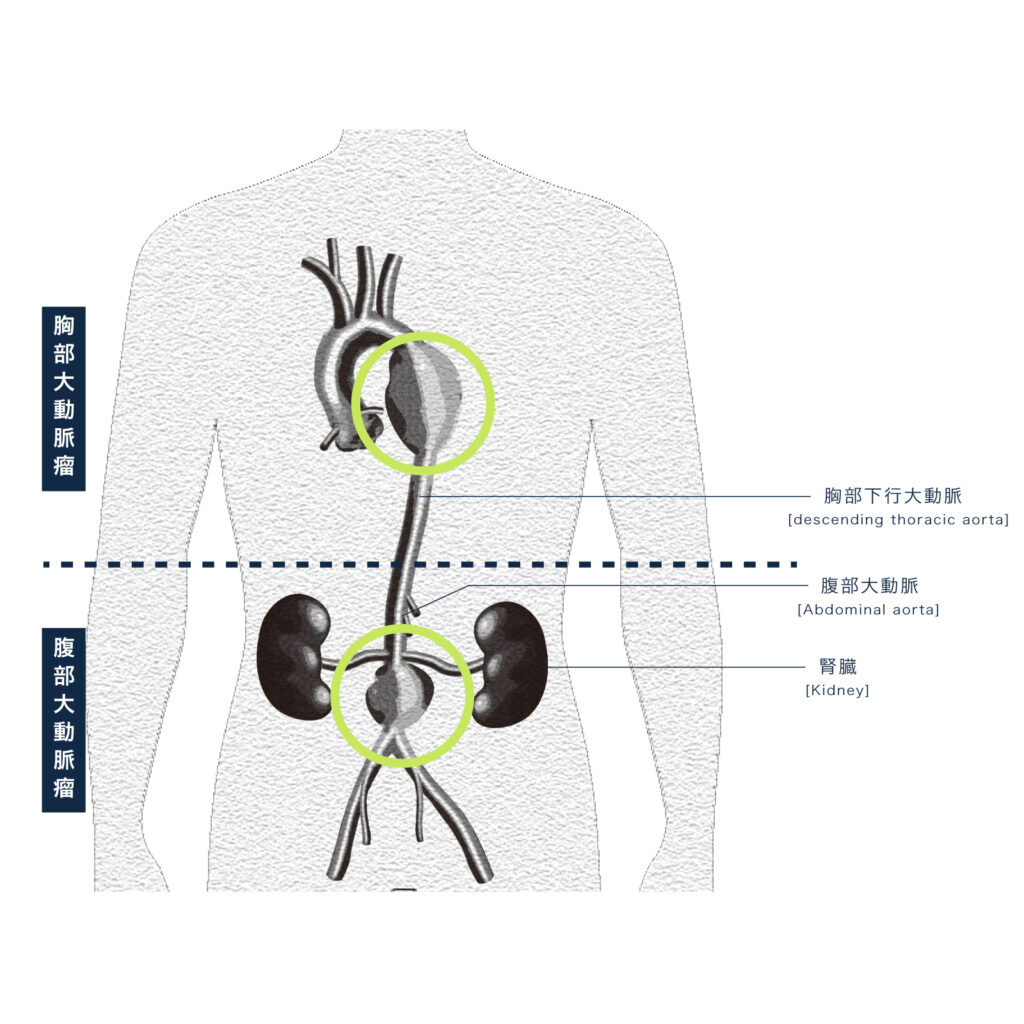
Inside the human body, the largest blood vessel, called the aorta, runs from the heart down toward the legs. Over many years, stress from blood pressure and age-related changes in the blood vessels, known as arteriosclerosis, can weaken part of the aortic wall.
When this happens, a section of the aorta may bulge outward, much like an old rubber hose that has become swollen and thin in one area. This condition is called an aortic aneurysm.
What makes an aortic aneurysm particularly dangerous is that even as the bulge grows larger, it often causes no pain or noticeable symptoms. However, as blood pressure continues to press against the weakened, thinned wall, it may eventually exceed its limit and suddenly rupture.
If rupture occurs, it can cause massive internal bleeding in the abdomen and become an emergency situation. For this reason, treating the aneurysm before it ruptures is extremely important.
2. Conventional Surgery vs. Newer “Non-Open” Treatment
So, how can an enlarged aneurysm be treated?
Conventional Treatment: Open Abdominal Surgery
Surgical Replacement with an Artificial Blood Vessel
In the past, the only available treatment was major open surgery. This involved making a large incision from the upper abdomen to the lower abdomen, removing the aneurysm, and sewing in an artificial blood vessel.
Although this is a reliable treatment method, it places a significant burden on the body and often requires a long hospital stay and rehabilitation period.
Modern Treatment: Stent Graft Treatment Without Opening the Abdomen
Endovascular Aneurysm Repair, or EVAR
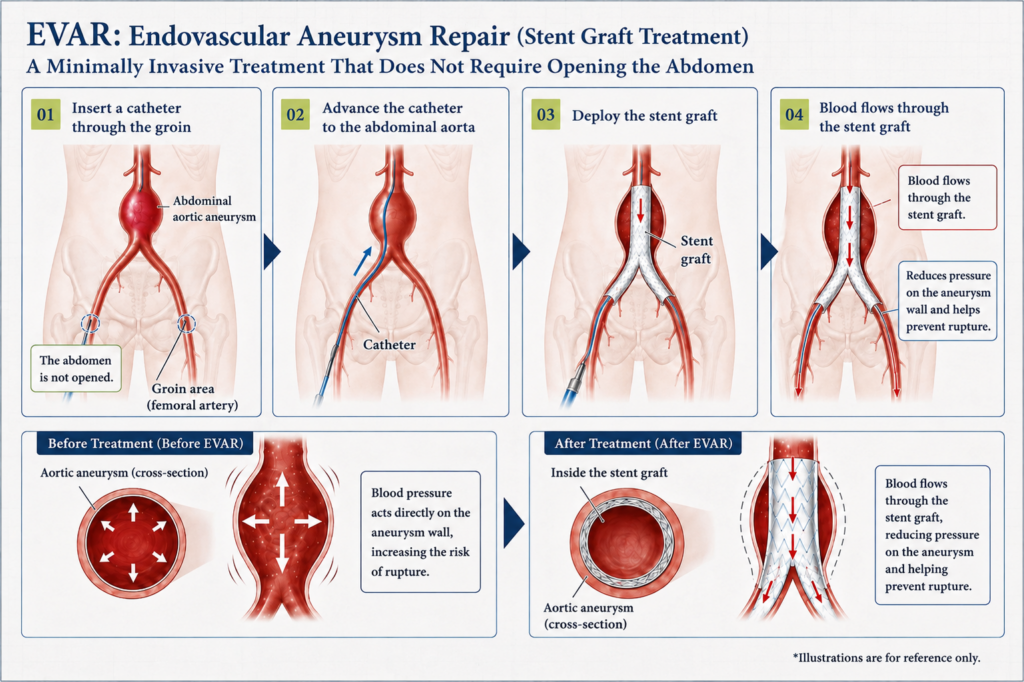
In recent years, a newer catheter-based treatment has become widely used. This procedure does not require opening the abdomen.
Instead, a small incision of less than one centimeter is made in the groin area. Through this opening, a catheter is inserted into the blood vessel. A device called a stent graft, which is an artificial blood vessel supported by a metal framework, is then expanded and placed inside the blood vessel.
Once the stent graft is in place, blood flows through the graft rather than directly against the weakened aneurysm wall. As a result, pressure is no longer applied directly to the fragile bulge, helping to prevent rupture.
3. Three Reassuring Benefits of Stent Graft Treatment
Compared with conventional open abdominal surgery, stent graft treatment offers several major advantages for patients.
1. Minimal Scarring and Less Pain
Because the abdomen does not need to be widely opened, postoperative pain is greatly reduced, and large surgical scars are avoided.
2. Suitable for Older Patients and Those Concerned About Physical Strength
Because the physical burden, damage to the body, and blood loss are much smaller, this treatment is easier to consider for patients who may have been told that major surgery would be difficult due to age or other medical conditions, such as heart disease.
3. Shorter Hospital Stay and Faster Return to Daily Life
With conventional surgery, discharge from the hospital could take several weeks to a month. With stent graft treatment, however, hospitalization is usually only a few days to about one week.
Patients can often begin walking soon after treatment and return to their normal daily lives more quickly.
4. Do Not Face Sudden Anxiety Alone — Please Consult Us First
Being told that you have an aneurysm can naturally make you feel afraid, as if it might rupture at any moment. However, whether treatment is urgently needed or whether the aneurysm can be monitored for a while depends on its size, shape, and overall condition.
We specialize in catheter-based, minimally invasive treatment that does not require major open surgery. We carefully assess each patient’s current condition and propose a treatment plan that places as little burden on the body as possible, while fully considering the patient’s lifestyle.
Even if you simply want to hear more about your options, or if you would like to better understand the current condition of your aneurysm, please feel free to contact us.
Medical Supervisor:
Shigeo Ichihashi