


“Waking up multiple times at night to use the bathroom,” “Weakened urine stream,” “Feeling like your bladder isn’t fully empty”—Are you suffering from these symptoms? It might be a sign of Benign Prostatic Hyperplasia (BPH).
While this is a condition many men face as they age, treatment options have significantly expanded in recent years. For those who feel that “the medication isn’t working well” but “are reluctant to undergo invasive surgery,” catheter treatment (endovascular treatment) is currently drawing attention.
In this article, we will explain in detail everything from the standard treatments for BPH to the benefits of the latest, minimally invasive catheter treatment.
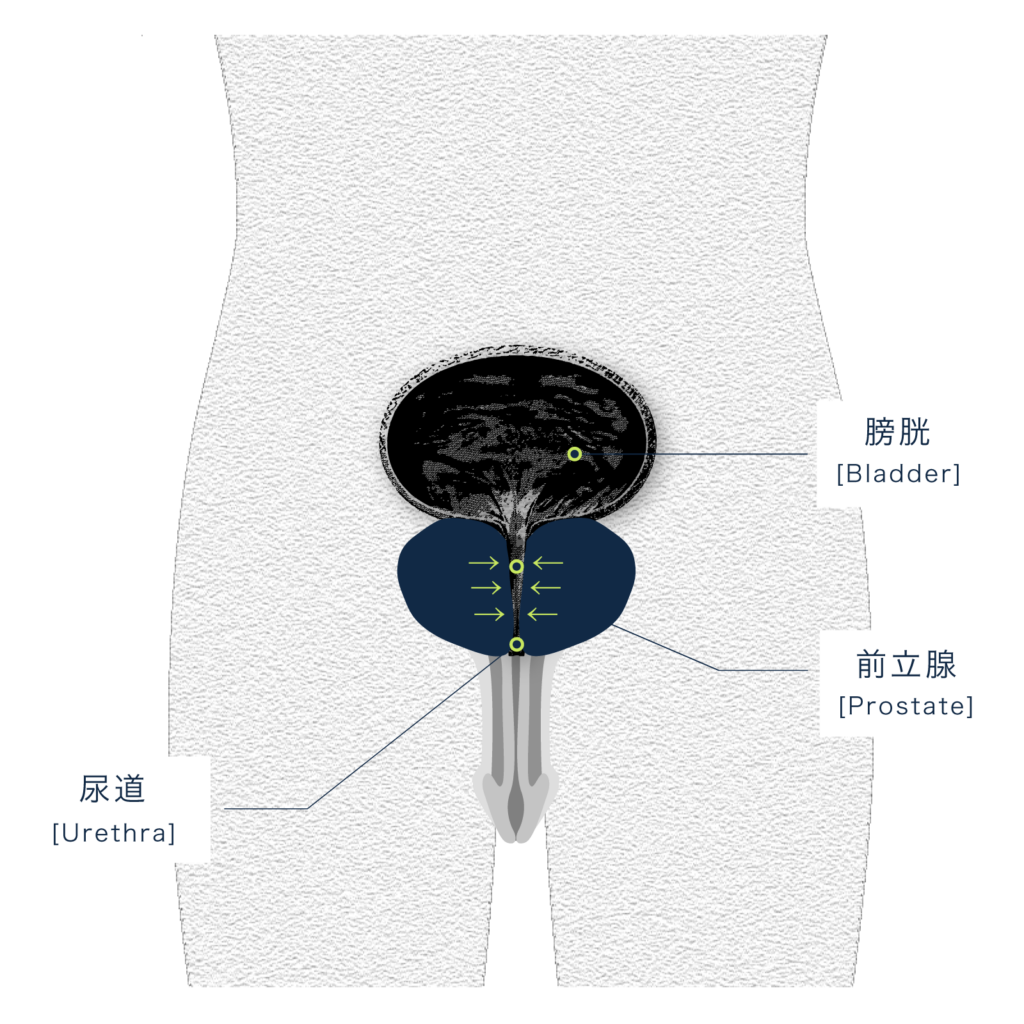
1.What Are the Standard Treatments for Benign Prostatic Hyperplasia?
Treatment for BPH involves several stages depending on the severity of the symptoms. Let’s first review the primary conventional treatment methods.
▪︎ Medication Therapy (Treatment with Drugs)
For mild to moderate symptoms, medication is often the first choice. Patients take drugs that relax the tension in the urethra to make it easier to urinate, or drugs that shrink the prostate itself.
- Pros: Easy to start, with minimal physical strain on the body.
- Cons: Not a fundamental cure; requires continuous use. The effects may be insufficient, and side effects (such as dizziness or lightheadedness) may occur.
▪︎Surgical Procedures (Resection, etc.)
These are considered when medication is ineffective or symptoms are severe. A typical example is Transurethral Resection of the Prostate (TURP), where an endoscope is inserted through the urethra to scrape away the enlarged prostate tissue.
- Pros: Since the enlarged portion is physically removed, reliable symptom improvement can be expected.
- Cons: Requires hospitalization (usually about a week). General or spinal anesthesia is necessary, and there are risks of complications such as postoperative pain, bleeding, urinary incontinence, and retrograde ejaculation.
“I want to cure it for sure, but I’m afraid of the pain of surgery, the long hospital stay, and the risk of complications.”
It is not uncommon for patients to feel this way and hesitate to seek treatment.
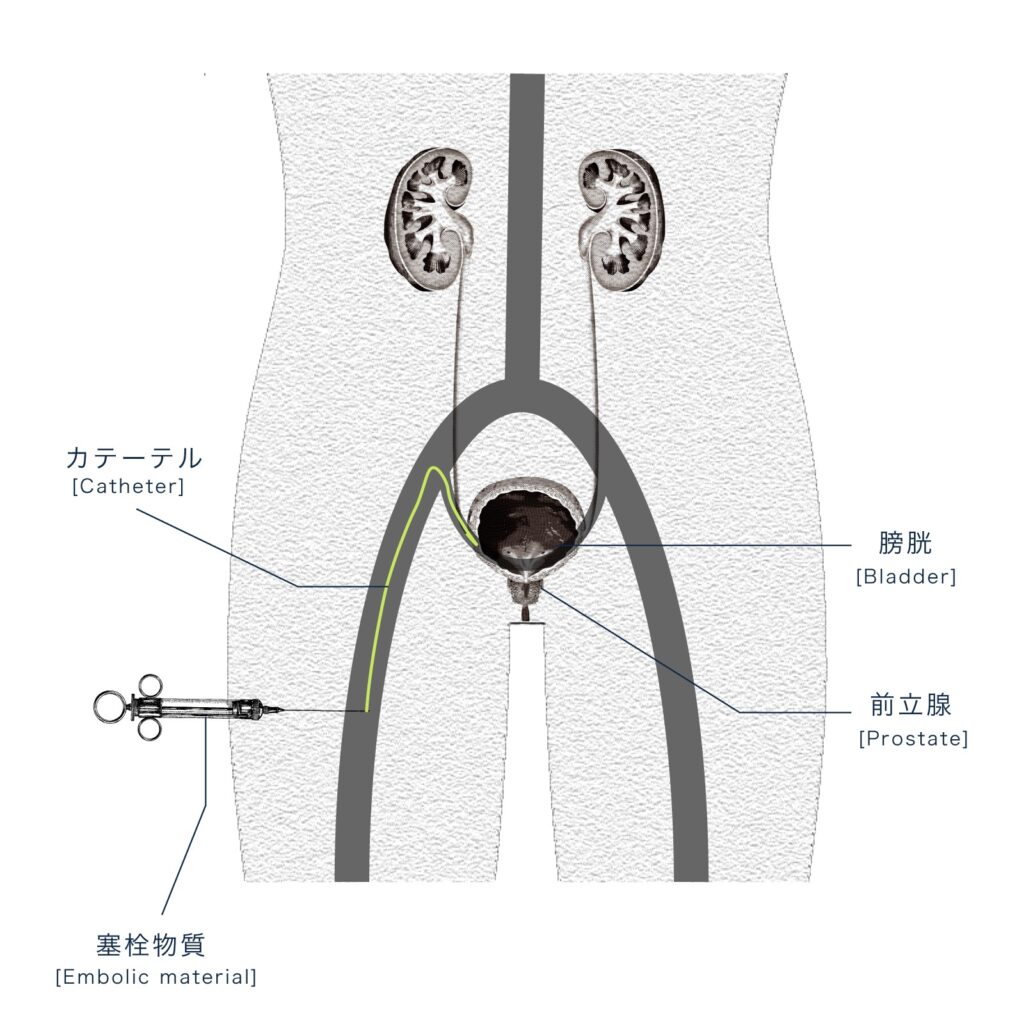
2. “Catheter Treatment (PAE)” A New, Non-Surgical Option
In recent years, a catheter treatment called Prostatic Artery Embolization (PAE) has been established as a new alternative.
How Catheter Treatment Works
Catheter treatment (PAE) does not “directly scrape” the prostate; instead, it takes the approach of “stopping the blood flow in the vessels (arteries) feeding the prostate.”
- A thin tube (catheter) about 2mm in diameter is inserted through a very small blood vessel in the wrist or groin.
- While monitoring X-ray fluoroscopy images, the catheter is advanced into the artery supplying the prostate.
- Tiny particles (embolic agents) are injected to block the blood flow to the prostate.
- Deprived of its nutrient supply, the prostate gradually shrinks naturally over several weeks to months, relieving the pressure on the urethra and improving symptoms.
3.”Three Benefits” of Catheter Treatment Compared to Traditional Surger
Compared to traditional surgeries (like TURP), catheter treatment offers significant advantages in the following areas:
Benefit 1: Minimal Physical Strain
Its greatest feature is that it causes very little pain, as it does not involve using a scalpel or inserting a thick endoscope through the urethra. Because it can be performed under local anesthesia without the need for general anesthesia, it is a safe and accessible treatment even for elderly patients or those with underlying medical conditions.
Benefit 2: Short Hospital Stays and Early Return to Normal Life
While traditional surgery requires a hospital stay of about a week, catheter treatment requires only a very short stay, such as a day trip or an overnight stay (1 night, 2 days). This is a major benefit for busy individuals who want to return to work and their daily lives as quickly as possible.
Benefit 3: Low Risk of Complications
Because the prostate is not directly damaged, the risk of complications often associated with traditional surgery—such as “postoperative urinary incontinence (urine leakage)” or “sexual dysfunction like erectile dysfunction or retrograde ejaculation”—is extremely low. You can undergo treatment while maintaining your dignity as a man and your quality of life .
- “I don’t want to keep taking medication.”
- “Surgery was recommended, but I’m anxious about the pain and aftereffects.”
- “I can’t take time off work, so I just want to get back to my normal life as quickly as possible.”
If you have any of these concerns, please do not hesitate to consult with us. We will propose a safe and effective catheter treatment utilizing the latest technology.
Medical Supervisor: Shigeo Ichihashi
Inquiries & Consultations
If you are suffering from symptoms of Benign Prostatic Hyperplasia, please feel free to reach out to us first.